
Vixa Vaughn Romance Books
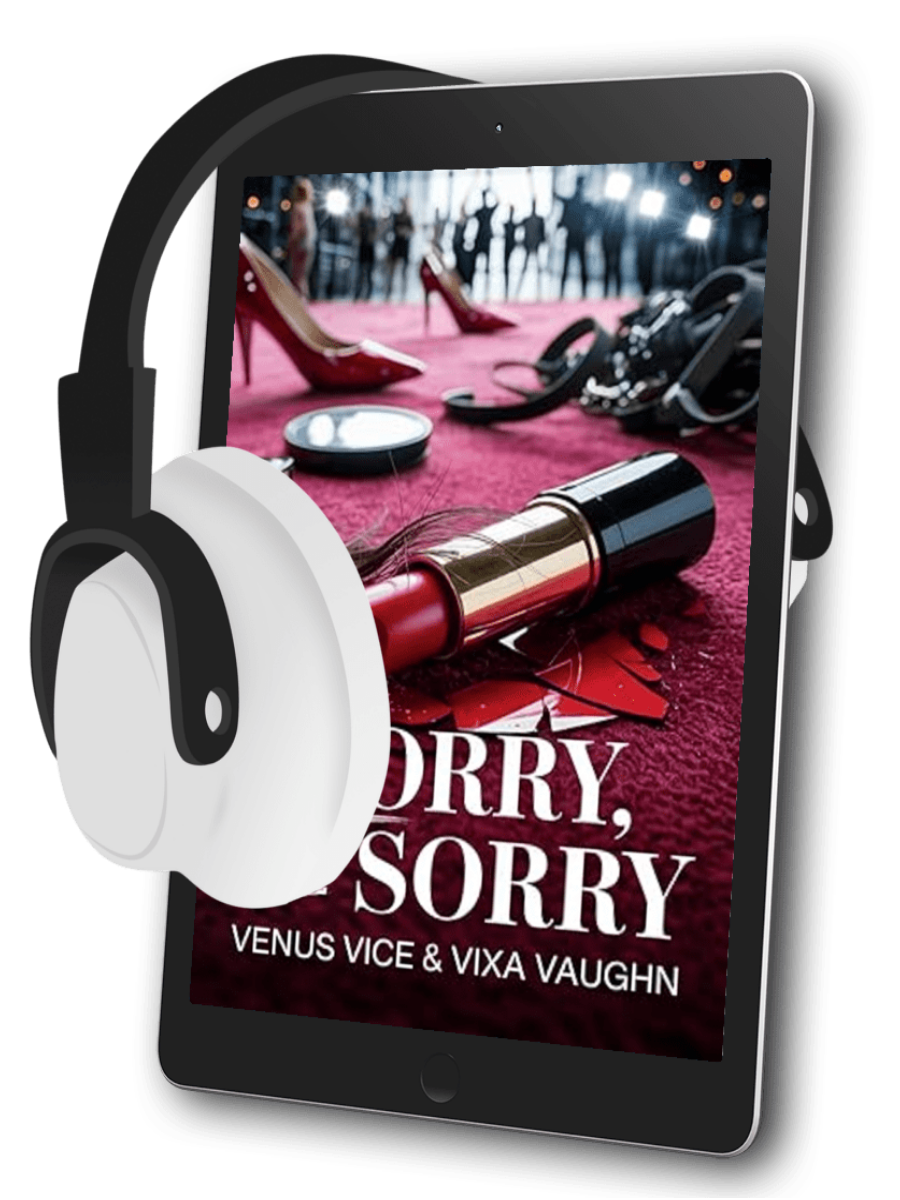
Sorry, Not Sorry | BWWM Stuntman Romance Audiobook (Dual Narration)
Sorry, Not Sorry | BWWM Stuntman Romance Audiobook (Dual Narration)
Couldn't load pickup availability
- Buy the ebook or audiobook
- Receive download link via email
- Send to preferred e-reader and enjoy!
She’s the one they photograph.
I’m the one who catches her when the lights cut out.
Zariah Creighton is Hollywood’s golden girl. Untouchable. Unbreakable.
Until the wire snaps.
Until I touch her like I’ve already claimed her.
They want her with the pretty boy.
But she looks at me like I’m the storm and the shelter.
I tried to stay in the shadows.
Now I’d burn every studio in this city just to keep her name in my mouth.
She says she’s not sorry.
She better not be…
Because I’m not done taking what’s mine.
Read on for backstage obsession, public scandal, possessive protection, and a stuntman who steps into the spotlight for her. HEA Guaranteed!
Look Inside
Look Inside
Chapter 1
Zariah
The lights don’t just flash—they sear.
They stitch heat across my skin in white-hot bursts, a staccato of attention that lands like sparks. I step out of the car into a tunnel of noise—my name ricocheting from one barricade to another, the syllables snapping like the crackle of kindling.
“Zariah! Over here!”
“Zariah, eyes left!”
“Zariah, the train—watch the train!”
I glide forward as if the carpet were poured just for me. The gown is silk that behaves like smoke; it clings when I want it to, drifts when I don’t, a clean white that will annoy every camera operator trying to correct their color balance. Diamond drops graze my collarbones. My hair is pulled into a sleek bun that makes my cheekbones look high enough to sign autographs of their own.
“Give us the shoulder!” a man in a vest yells, already angling his camera.
I give them the shoulder. The chin tilt. The half-smile like a secret I will not share for free.
“Who are you wearing?” a blonde asks from behind the velvet rope, her mic thrust like a sword. The red light on it is a tiny threatening eye.
“Something that doesn’t wrinkle under pressure,” I say, and the crowd laughs in that pleased, surprised way that means I’ve fed the beast and kept my hand.
They chant my name again. I wave, slow and sure. My cheeks make the muscles for a smile without me. They know their choreography by now.
“Okay, you’re on fire.” Kiara materializes at my elbow like a stylist-shaped guardian angel, fingers quick at my lower back. She tucks a loose thread, smooths the fabric with a palm. “No, actually—lift your arm. The zipper’s thinking about rebellion.”
“Threaten it with a safety pin,” I murmur through lips that keep smiling. “Tell it my agent knows people.”
She snorts. “Baby, your agent knows everyone.”
The microphones lean closer, a garden of metal flowers in bloom. “Zariah, is it true you did your own stunt in scene twelve?” a reporter calls.
“Define ‘own,’” I say, settling into banter like a familiar heel. “I fell dramatically in slow motion while extraordinarily talented people made sure I didn’t break anything people would miss.”
“And those extraordinarily talented people would be…?” His eyebrows pitch up.
I could say his name. My throat knows it. Instead, I let the pause be my answer and move along the line, stepping from X to X on the carpet like stones across a river. Fans scream. One girl in a sequined blazer holds up a hand-lettered sign: YOU SAVED ME. NO REASON. I LOVE YOU.
I press my palm to my chest for her. She bursts into tears and I pretend I don’t want to do the same.
Marlene glides into my peripheral vision, six inches of heel, a red lip sharp enough to cut fruit. “Breathe,” she stage-whispers from behind her publicist smile. “But do it without moving your ribcage. We’re trending in forty-two countries.”
“Just forty-two?” I keep the smile, bend toward a microphone. “Unacceptable.”
“Turn your head three degrees to the right,” she murmurs, not missing a beat. “The camera two rows back is a demon that eats beauty. Stop feeding it.”
I turn three degrees to the right. The demon hisses and backs down.
I am good at this—at being beautiful without being human. I know how to inhabit the light without letting it inside. It’s a trick I learned the first time a photographer told me to “open up,” and what he meant was “give me the part of you you don’t show anyone.” I learned how to give him the shape of that part without the substance.
I dance with the flames, I don’t let them up my dress.
A laugh shakes the barrier to my left. Fans jostle and squeal, and the security guard—bored, sweaty—pats the air like he can calm a hurricane. The carpet curves toward the theater; the ballroom waits beyond for the premiere table read, chandeliers throbbing gold in the distance.
“Zariah.” The new voice purrs like a cat has swallowed a microphone.
Here comes the weather.
Ronan Steele steps onto the carpet with an ease that reads as entitlement. Cameras adore him; he’s built for it—symmetrical bones, artfully disheveled hair, a tux that looks smug. He moves in with cologne like a forest set on fire by money.
“Lethal,” he says, low and intimate as if there aren’t eighty lenses between us. He kisses the air near my cheek. His breath is warm and a fraction too close. “You’ll be the only thing people remember tonight.”
“I always am,” I say lightly, and the cameras eat it.
“Walk with me?” His palm hovers near my waist like an assumption.
“I’m mid-walk.” I step forward one pace and steal the choreography back. “Try to keep up.”
He laughs, a rich, ringing sound that could buy a lake house. “There she is.”
There she is. As if the version he prefers of me is a place he can visit. As if his ticket gets him access.
“You two!” calls the blonde mic again, vibrating with dopamine. “A photo together?”
Ronan pivots his body to frame me in a triangle of light. He knows his angles. I know mine. We give the cameras what they want—foreheads a breath apart, two beautiful animals at a salt lick.
As the flashes throb, the fine hairs on my neck rise. Not for him. For something else.
My eyes slide past his shoulder, toward the outer ring of the carpet where the lighting rig meets the world and therefore most people forget to look.
He stands just outside the heat like a shadow that learned to be a man—black fitted T-shirt, cargo pants that have seen more living than tuxedo slacks, boots that could bite a mountain. His posture is quiet steel. The short coils at his nape reflect a thin hilt of light. He carries a stack of scripts under one arm like the weight of them is nothing.
Malik Wren doesn’t smile for the cameras. He doesn’t even seem to notice them.
He notices me.
It isn’t hunger. It isn’t even curiosity. It’s study. His gaze moves over me like a hand that knows how to find a pulse. It lands on my eyes and holds. It doesn’t ask.
I feel something in my chest tilt.
And he looks away. Not as an insult. Not as a game.
As if the data he needed is collected and catalogued and filed under “danger.”
“Zariah?” Ronan says, caught by the angle of my face, following my line of sight. “You know him?”
“Professionally,” I say.
“Professionally.” His lips curve. “We should all be so professional.”
“Some of us are.” I move past him before his chuckle can try to fill me.
Kiara ghosts a breath near my ear as we pass the final step-and-repeat. “We love a well-timed exit.”
“Put it on my tab,” I murmur, and the doors swallow the roar.
Inside, sound becomes velvet. The lobby is marble and echo—people who live under hot lights pretending they understand shade. Publicists text with thumbs that blur. Champagne floats in shallow rivers on trays; dresses rustle like expensive secrets. Posters ten feet tall show me looking fierce and tragic under stormy skies. She’s beautiful. And she’s exhausting.
“Darling.” Marlene hooks two fingers into my elbow and steers me toward the ballroom like a yacht aligning for port. “Our director’s to your left, our financier’s to your right, and your favorite journalist is foaming near the topiaries. We will greet the director, pretend to love the financier, and make the journalist promise to spell your name right.”
“She still adds an extra A?”
“She adds extra vowels to everything. Stability frightens her.”
“Sounds like most men I’ve dated.”
“That would require you to date.”
“I date.”
She twists a look at me that says: publicity dinners do not count.
We sail into the ballroom on a tide of strings and good posture. Chandeliers descend like star clusters. The long table waiting at the front has place cards under crystal; the smaller tables in horseshoes around it are stacked with scripts and branded notepads, each chair tucked with precision like the event has been staged to within an inch of itself.
Adrienne, our director, comes in like a storm with bangles. She kisses my cheeks and both my eyelids, somehow. “You look like the white flag every war has been waiting for,” she sings. “You’ll kill them tonight.”
“Alive on arrival,” I say. “And you look like the hurricane that did the damage.”
“Effusive flattery belongs to the financier,” Marlene says, still smiling. “Who has opinions about art despite never having met any.”
“Not true,” Adrienne says. “He once met a Jackson Pollock and asked if he could get it ironed.”
We giggle like girls caught in a cabinet with the best liquor. It’s a relief I’ll pay for later.
“Places!” someone chirps from the front, and we pivot.
Ronan appears at my side without using any doors, slinging an arm over the back of my chair in a way that doesn’t technically touch me. “Ready to be unforgettable?” he asks.
“I already told you—I always am.”
“Practice makes perfect,” he says.
“Perfection is boring,” I say.
“Then thank God you’re not,” he says, and the smile he shoots at me is beautiful and empty, like a house staged so well no one could possibly live there.
I’m fine. I’m always fine. I’m a professional at fine. I fold the script open to the title page and breathe only to keep my lungs obedient.
Movement brushes the edge of my vision. Malik sets a stunt breakdown packet in front of me. He doesn’t announce himself. He doesn’t hover. He places the paper like a question and steps back like I’ve already answered.
The scar peeks at his temple like a private thought. His eyes are darker up close—nearly black, watchful. I take the packet and let my fingers skirt his. He does not flinch. He also does not hold.
“Thanks,” I say.
“Read the notes on twelve,” he says, voice low and gravelly like a late-night radio station that only plays songs with secrets. “Rigging’s been adjusted. Don’t trust your muscle memory.”
“I never do.”
One corner of his mouth thinks very carefully about smiling and then declines the invitation. “Good.”
Ronan watches this exchange with a theatrical interest so heavy it should have its own billing. “Wren,” he says lazily, as if they’re old friends or old enemies and he can play either. “You keeping our girl in one piece?”
“Trying,” Malik says.
“Try harder,” Ronan says, amiable as a lit match.
Adrienne claps for quiet. People shush out of habit. Pages lift and fall. We begin.
The read is a living organism—it hushes, it hums, it lunges when Ronan chews into a line like it owes him money. He throws me looks that aren’t in the stage directions and leans closer when the dialogue doesn’t ask for it. Laughter blooms in polite patches at his ad-libs. He is charisma in a tux, and if you don’t look too closely, you could mistake the shine for substance.
I don’t look too closely. I’ve seen this show.
What I do look at is the margins: Malik, two tables back, head bent over the stunt notes, pen tapping against his thumb. When a line references a fall, his eyes lift to me as if checking the geometry of my bones against the fall he’s planning. When Ronan’s fingers curve over the back of my chair again, Malik’s jaw flexes like the muscle is remembering something it promised itself.
We break after scene six. “Hydrate,” Adrienne sings, and sixty people pretend they’ve never heard a better idea.
Ronan is there before my glass can find a tray. He holds a flute of champagne like an accessory, eyes cut to my mouth. “Scene twelve,” he says in a confidential purr. “We should rehearse privately.”
“It’s a group harness stunt,” I say, amused. “Are we rehearsing the harness in private?”
“Don’t threaten me with a good time.”
“I would never threaten you with anything you’ve been preparing for your entire life.”
He laughs, delighted, and steps closer. The perfume of his attention folds around me—pleasant, suffocating. “You’re in a mood.”
“Awake?”
“Sharp.” He lets the back of his knuckle skim the air near my bare shoulder, never touching. It feels like he’s trying to. “I like you sharp.”
I angle away so the gown rocks sunlight. “Your likes are noted.”
A shadow intercepts. Not in the way men make shadows by trying to be bigger. In the way a wall casually exists and you just notice when you run into it.
“Sorry,” Malik says, not sounding sorry. He sets a coil of harness at my table, glances at me, then down. “We need to talk through your connection point for the swing. You’ll be heavier in the harness because of the gown layers. If you’d worn something sensible—”
“Perish the thought,” I say.
“—we could use your hips. As it is, we’ll move the point higher.”
“Will I look like a marionette?”
“If we do it wrong.” He lifts his eyes. “We won’t do it wrong.”
Ronan’s smile thins. “She’s an actor. She can act like it doesn’t look wrong.”
“She’s a person,” Malik says, and the sentence has an edge. “Her spine isn’t required to act.”
“Boys,” Adrienne sings, diving between us with a liquid smile. “Let’s keep our swords in their scabbards and our metaphors clean. We’re all on the same team.”
“Of course,” Ronan says. The way he smiles at Malik suggests he’d like to know exactly how hard it would be to push him off a balcony.
“Come with me,” Malik says to me, clipped. “We’ll do a quick run in the side hall. Gown stays, heels stay. We work with what we have.”
I glance at Marlene. She gives me the smallest nod. She doesn’t love letting me out of her line of sight, but she loves the idea of me not breaking something more.
The corridor off the ballroom is quieter, carpeted sound and framed posters of other people pretending for money. DeShawn—one of the stunt team, all shoulders and kindness—waits with a padded belt and the kind of grin that could rescue kittens. “Queen Z,” he says. “You look like trouble.”
“I look like tax brackets,” I say. “Make me safe, please.”
“We make you safe,” he says, “you make us look good. Symbiosis.”
Malik stands in the center of the hallway like he’s built into it. He gestures at the belt. “Step in.”
“You buy me dinner first?” I slide into the harness and DeShawn fastens it around the narrowest part of me. It’s snug and ungentle in that reassuring way seatbelts are. Malik steps close enough that his heat impresses itself through silk. He doesn’t touch until he has to. When he does, it’s with careful, practical hands.
He brushes my hip to test the tightness, then flattens his palm against my lower ribs to check the anchor. The contact is clinical and not. He is listening to my body without pretending it’s speaking to him.
“Breathe in,” he says.
I do. His palm rises with my breath. His eyes track the movement but not in the way men usually do. He is measuring. Calibrating.
“Breathe out.”
I let it go. His hand lowers with the same care a person gives a match and the dark.
“You’re overthinking,” I say, because the silence between us feels like it’s heavy with things we’re not allowed to say yet. “Do you always run disaster scenarios in your head?”
“Yes.”
“And in those scenarios, do I die tragically or fabulously?”
“That depends on whether you listen.” He steps back, and air chills where his hand was. “We’re going to mimic the swing. DeShawn will take the lead. I’ll spot.”
“I love when men fight over me,” I say, deadpan.
“Great,” DeShawn says cheerfully. “Fight over you by not dropping you.” He winks. “Ready?”
They raise me just enough to feel the harness take my weight. The corridor truncates into tunnel vision. I swallow—memory in my body of other rigs, other days. A prop glass that cut me last year; a director who told me to be braver when the bruise on my thigh still flowered. The sensation isn’t fear. It’s rehearsal for it.
“You okay?” Malik’s voice threads through the sound.
“I’m good.”
“We’ll do a gentle arc,” DeShawn says, easing the line. “Lean with it. Don’t fight.”
I lean. The sweep carries me half a step; the gown sighs. I open my arms because I know how it’ll look on-camera. I feel the pull at my ribs, the anchor learning my body.
“Again,” Malik says.
We do it again. And again, a fraction wider, a fraction higher. The third time, my heel scuffs the carpet and the harness tugs at an angle. I wobble, breath catching on nothing, just enough vertigo to make the world skinless.
He’s there before the wobble finishes wobbling. One hand at my spine. One at my shoulder blade. He steadies me with more care than effort.
“I’ve got you,” he says.
He does.
I swallow, the taste of heat on my tongue where fear would usually live. “If you drop me,” I say lightly, “I’m haunting you.”
He releases me in degrees, like heat turned down on a stove. “You already are.”
“Excuse me?”
“That dress,” he says, bland. “It’s a fire hazard.”
DeShawn cackles. “Don’t let him fool you, Queen Z. He wrote a love poem to that harness last week.”
“Go back inside,” Malik says to me, ignoring DeShawn. “Drink water. Stretch your neck. In scene twelve, I’ll be at the base of the rigging. If something goes wrong, I’ll be where you fall.”
“That’s reassuring because you’ll catch me,” I say, “or because you’ll break my fall with your body like a heroic crash mat?”
“Yes.”
I try not to smile. It shows teeth anyway. “Bossy.”
“Alive is the goal.” He glances toward the ballroom. “Go be adored.”
“I’m working on it.”
He steps back, and the corridor remembers it’s a corridor.
On my way in, I pass Ronan leaning against a poster of himself. He watches me like I am a choice he keeps making. “Private rehearsal with the help,” he says, soft. “How practical of you.”
“Practical is the new sexy,” I say.
“Then I’m a prude,” he murmurs.
“You said it, not me.”
He flicks his gaze down to where the harness peeks beneath the silk, invisibly bulking the line of my ribs. “I liked you better when you were breakable.”
“You liked me better when you didn’t know I wasn’t,” I say, and leave him to drown in his reflection.
Back at the table, Marlene pretends she hasn’t tracked me like a hawk through drywall. She slides a bottle of water toward me. “Sip,” she says, smiling for a donor in a sapphire gown who wants to believe I’m grateful to be seen. “Don’t chug. Chugging is for civilians.”
“I’ll lose my union card if I hydrate,” I whisper.
“You’ll lose your human card if you trip on that hem,” she whispers back. “Less heroics, more headlines.”
“Noted.”
We dive into the second half of the read. The room loosens—fewer eyes on me now that the novelty of my face has re-warmed itself in everyone’s memory. Ronan ratchets up the heat, pushing me in the dialogue, daring me to meet him in a place the script doesn’t require. I can keep up with him and outpace him when I want to. Tonight I don’t want to give him oxygen.
At the scene where my character chooses herself over the man who lies beautifully, the room goes quiet. I feel the silence like a weight lifted off a chest. I let my voice aim for the soft part of the ribcage—right where breathing starts. The line lands. Even the financier blinks like something tender tried to touch him and he forgot how to accept it.
From the back, I feel Malik watching. It doesn’t feel like being stared at. It feels like someone left a porch light on for me.
We close on applause that sounds expensive. People rise in a rustle of fabric and relief. The ballet of congratulations begins—everyone finding the exact right elbow to touch, the exact right “You killed it” to deploy, the exact right “We’re so lucky to have you” to appear generous and strategic.
Ronan slides in at my side with a grin that could sign autographs by itself. “Drinks upstairs,” he says, fingertips hovering near my waist again. “Come be adored somewhere with better lighting.”
“Lighting here is fine,” I say.
“What about the company?” He leans, whisper-soft. “You look like you need a firm surface to lean on. I volunteer.”
“I’ve been standing on my own since I could stand,” I say, letting steel lace the words. “Appreciate the volunteerism.”
Marlene inserts herself with surgical timing. “Zariah has to greet the sponsors.”
“Always the sponsors,” Ronan says, mock-suffering. “Fine. Five minutes, and then I’m stealing her.”
“You can try,” Marlene says pleasantly, and steers me toward the cluster of men who own too many boats to ever be on any of them.
We do the dance. I sign a program for a woman who calls me “dear” like I’m a granddaughter she’s proud of and doesn’t understand. I pose for photos with a mayor whose teeth look like they were carved by a god that only cares about orthodontia. I tell a PA he did a good job with the seating chart and mean it.
At the edge of the ballroom, Malik leans against a column like he was built there. DeShawn talks with his hands; Malik listens with his eyes. A producer tries to hand him a drink; he shakes his head. He watches the room and the room doesn’t know.
I excuse myself from a financier’s anecdote about tulips and approach the column like it’s not a gravity well. “I thought you didn’t do parties,” I say.
“I don’t,” he says.
“This is one.”
“I’m working.”
“You’re leaning.”
“I can lean and work.”
“I believe you,” I say, lightly. Then, when he doesn’t offer me a crumb of conversation: “Do you have something against small talk?”
“Yes.”
“What did small talk ever do to you?”
“Wasted my time,” he says, and then—like he recognizes the sharpness and sands it down a fraction—adds, “It’s not personal.”
“It feels personal,” I say.
“Because you’re used to it being personal.”
I tilt my head. “And you’re used to people not expecting anything.”
He meets my gaze then, full. It’s not a challenge. It’s a reference point. “I’m used to people expecting me to catch them and disappear.”
“What if I don’t want you to disappear?” The words slip out softer than I intended. It feels like dropping a glass and waiting to hear whether it shatters or bounces.
His eyes flick to my mouth, then back to my eyes. “Don’t fall,” he says.
“That’s your safety briefing?”
“For now.”
“Terrible bedside manner.”
“I’m not your doctor.”
“Good thing,” I say. “I don’t listen to doctors either.”
The edge of his mouth considers that. I want to reach up and coax it the rest of the way into a smile. I settle for a sip of water and pretending I don’t want anything from him at all.
“Zariah!” Ronan materializes like an alert gone off on my phone that I forgot to turn off. He slides between me and the column, replacing Malik’s shadow with his own. “There you are. I thought you’d abandoned me to the wolves.”
“I don’t abandon,” I say. “I outsource.”
“Outsource drinks with me.” He takes my wrist—lightly, friendly, proprietary in a way the cameras will read as romance and my skin reads as warning.
Before I can twist free, Malik straightens. He doesn’t lunge. He doesn’t loom. He simply shifts from leaning to standing in a way that adjusts the architecture of the space.
Ronan’s fingers fall away like they were never there at all.
“Careful,” Malik says, voice even. “You’re near the step.”
There is a step. Half an inch of marble that could turn a heel into a headline. I hadn’t seen it. Ronan didn’t either. He looks down, finds nothing to dramatize, looks up with a smile that has lost a tooth.
“I’d hate for her to trip,” he says.
“You would,” Malik says, and the three quiet words sound like a thesis on the subject of hate.
“Gentlemen,” I say, before Adrienne’s bangles can be heard approaching to scold us all. “I promised the sponsors my soul for three photos. Let me keep my bargains.”
Ronan bows, mock-chivalrous. “I’ll collect you after.”
“I’m not dry cleaning,” I say.
“Now you’re just teasing,” he says, and peels off in search of an audience that claps easier.
I take one step—not onto the marble edge, but around it, because I learn even when I’m not in class. Malik doesn’t move.
“Thank you,” I say. It’s a small thing. It is not nothing.
“You’re welcome,” he says.
“For the step,” I add.
A beat. “I know.”
“And the harness.”
Another beat. “I know.”
“And the way you look at me as if I’m not a product,” I say, before I can stop myself.
His throat works once, the smallest movement. “That’s because you’re not.”
I feel that sentence where I keep the ones I don’t say out loud.
Across the room, Marlene raises a glass at me, then points at the cluster of donors with a look that says “Smile like your life is a billboard.” I roll my shoulders back and obey.
On my way, a woman in a green dress stops me and tells me her daughter watched my first film twelve times the week she shaved her head after chemo. “You made her feel pretty,” she says, and I say “She was,” and somehow both things are true and not enough.
We pose for a photo I hope the girl sees.
The night unspools. Applause stacks into piles. Compliments roll like coins across velvet. Somewhere, press releases are being born, slippery with spin. I do the job. I do it well. I act like I was born inside a camera and learned human behavior from the handbook.
But every so often, I feel the prickle of being watched—not the fluorescent glare of a hundred strangers, but the steady warmth of one man who knows the difference between spectacle and risk. When I glance toward the columns, I don’t always find him. Sometimes he’s gone, and the fact of his absence rings under my breastbone like a struck glass.
Ronan makes good on his threat near the end, reappearing with a tray and two drinks like a magician trying to prove the trick is love. “To the only reason this town still tries,” he says, and lifts a glass.
“I drink to finish a job,” I say, taking the water Marlene materializes and pressing it to my bottom lip, never breaking eye contact. “Not to tolerate one.”
“Then drink to both,” he says. “You can do two things at once.”
“I can,” I say, and do neither.
He laughs like I’ve flirted and strolls away to find a yes.
Marlene slides in behind me again, smile laminated to her face. Under it, her whisper is tactical. “Tweet the thank you. Post the behind-the-scenes photo of the white room. Repost the makeup artist’s TikTok. Pretend the financier told a good joke.”
“He didn’t.”
“He didn’t,” she agrees, eyes sparkling. “But pretending is currency. Cash it.”
“And the rumor that Ronan and I are—”
“We’ll ignore it until we can use it,” she says. “And then we’ll kill it when it threatens the narrative.”
“What’s the narrative?”
“You, beloved and inevitable. Him, lucky to stand near you.”
“Useful,” I say.
“True,” she says. “Also—be careful with Wren.”
I lift a brow. “Because?”
“Because I can’t read him,” she says, and for Marlene, that’s the same as a fire alarm. “And because you can.”
I swallow a smile that wants out. “I’ll be careful,” I say.
“Be brilliant,” she corrects. “Careful is for people who don’t trend.”
The event thins. Spouses retrieve each other. Assistants pack the branded pens like treasure. Adrienne kisses me like we have always been cousins. DeShawn salutes me with two fingers and slips out the service door with the harness on his shoulder like an obedient pet snake.
When I finally step into the lobby again, the night outside looks cooler than humans deserve. The crowd out front has thinned to diehards and tourists; the carpet is a red ribbon rolled back onto its spool. I take a breath that isn’t for a camera. It tastes like air, not applause.
Movement to my left—quiet, easy. Malik pushes the service door with a shoulder and steps into the lobby shadows, the rigging bag slung low. He doesn’t see me at first. He looks up. Our eyes catch.
“Long night,” I say.
He glances at the glass doors, the last flickers of flash retreating. “Depends who you ask.”
“If I ask you?”
He thinks. “Necessary.”
“Fair.” I watch the shape of his mouth in the dim, the way restraint lives there like a tenant who pays on time. “You saved me from an embarrassing headline.”
“The step,” he says. “It’s stupid.”
“Stupid can break ankles.”
“So can arrogance.”
“Are you calling me arrogant?” I ask, amused.
“I’m saying you think you can walk on water,” he says. “And water is slippery.”
“I prefer fire,” I say.
“I noticed.”
Silence settles, not awkward. A new kind of quiet I haven’t been offered in a while.
“Goodnight, Malik,” I say, because I need to end this before I start something. Before I ask him why he looked away on the carpet like I wasn’t a thing worth burning for. Before I admit that his silence felt like defiance in a world where everyone else worships at my feet.
“Goodnight, Zariah,” he says, my name like a promise in his mouth, like something he’s decided not to spend yet.
I step toward the waiting car. The driver holds the door, the interior humming with air-conditioned privacy. I pause with one hand on the frame and glance back.
Ronan is outside on the curb, talking to a reporter with his back to the door. He throws his head back on a laugh that could sell a fragrance. He glances over the reporter’s shoulder and catches me looking. He lifts two fingers in an easy salute that says: you and me, the story writes itself.
I hold his gaze and let mine say: only if I pick up the pen.
Through the glass, across the lobby’s dim and chandeliers, Malik watches me not choose either of them.
For a heartbeat, it feels like I’m standing in the middle of the fire and it isn’t burning me at all.
The door thunks closed. The car pulls away. My phone lights up with a hundred messages—emojis and exclamation points and two-word prayers: SO PROUD. CALL ME. U ALIVE?
I mute the world.
The city slides past, smeared neon and black water. My reflection in the window looks like a girl someone drew from memory and forgot the flaws that make her human. I press a fingertip to the skin under my eye where the makeup is thick, and for a second I imagine wiping it away, showing up somewhere as myself and not the idea of me.
My hand falls to my lap.
When I finally kick off my heels in the quiet of home, my feet throb their opinion. I laugh into the dark, alone in the only way that counts. My phone buzzes on the counter.
Marlene: PERFECT NIGHT. DON’T RUIN IT. LOVE YOU.
A photo follows of me and Ronan on the carpet, foreheads almost touching, the caption already drafted: THEY SIZZLE.
I stare at the photo until the white dress stops looking like armor and starts looking like a target. I put the phone face down.
Before I turn off the light, I see a square of paper peeking from my clutch. Not mine. Tucked there like a secret.
Handwriting, small and clean: Scene twelve—don’t trust muscle memory. Look left on the swing. I’ll be there.
No name. Doesn’t need one.
Everyone else tonight worshiped. He warned.
And his warning feels like the first honest thing I’ve been given in weeks.
I slide the note under my jewelry tray and lie back, the city’s low hum a lullaby I don’t deserve. I close my eyes and see a room full of cameras, a man who smiles like a marquee, a woman who knows how to survive them both—and the quiet shape of a stuntman who looks at me like he’s measuring where the danger really is.
Ronan burns hot and obvious. Malik, though—his silence is a different kind of fire.
The kind that doesn’t ask permission before it remakes everything it touches.
Share